AI Is Reshaping Every Part of My Life. Here’s a Week of Proof
I tracked one four-day working week in April 2026: AI tools saved an estimated 37 to 52 hours across finance, software and content work.


AI didn’t just make me faster this week. It changed what one person can realistically carry.
I know that sounds like hype. So I measured it.
I am the CTO and COO of Modaso Energy, a renewable energy developer focused on African markets. I build software. I manage a personal investment portfolio. I have a seventeen-year-old whose birthday was this week. I train Brazilian jiu jitsu. I try to sleep.
Last week, 6 to 12 April 2026, a four-day working week because Monday was a public holiday – I tracked everything. Every meeting, every code commit, every trade decision, every article, every walk. All of it flows through my AI systems automatically, so the data was already there. I just had to look at it.
The total estimated time saved across all AI tools: 37 to 52 hours. More than an entire additional working week.
Here is what that actually looked like.
Running a code review from a shopping mall
On Saturday afternoon I was at the mall with my son, birthday shopping. While he was trying on trainers, I pulled out my phone and connected to Claude Code running on my laptop at home using the new remote-control function over Tailscale.
From my phone, in a shoe shop, I kicked off a full testing analysis of one of my apps — browser automation, functional checks, the lot. Claude Code ran the tests, flagged two regressions, and I approved the fixes before we reached Starbucks.
That is not a productivity hack. That is a fundamentally different relationship with work. Deep technical tasks no longer require me to be sitting at a desk. They require me to be reachable for decisions.
The week in numbers
The raw data from the week:
- 16.1 hours of Teams calls across 12 meetings
- 53 code commits, 13,042 net new lines across 101 files
- 7 strategic and financial tasks completed supported by Claude
- 1 long-form article written and published to 4 platforms
- 12 X posts, 8 generated from that article (8,000 impressions, 400 profile views, new Substack subscribers)
- 3 major AI infrastructure updates to my Openclaw.
- 2 jiu jitsu sessions, a run, and 40km+ of walks with my wife as she trains for the Camino de Santiago this summer
- Average 6h 50m sleep (Whooptracked)
All in four working days plus the weekend.
The AI layers that made it possible
I don’t use one AI tool. I use separate AI layers for strategy, coding, content, and automation, each tuned for a different kind of thinking.
The game-changer this week was Claude Code. The ability to run a full-stack coding agent in parallel with the rest of my life, in meetings, on the move, even from a shopping mall, is what turned a four-day week into five weeks of output. Nothing else comes close to that compression.
But behind the headline tools, I also run a team of AI sub-agents through OpenClaw, my self-hosted agent framework. They handle the continuous background work that would otherwise pile up between meetings.
James: keeping my head straight in a volatile market
It was an extremely volatile week in the markets. My finance sub-agent James, part of my self-hosted OpenClaw framework, ran continuous portfolio analysis throughout the week. Risk scenarios, exposure breakdowns, strategic action recommendations.
In a normal week I might spend an hour or two reviewing positions. This week, with markets moving sharply, I would have needed hours of focused analysis to stay on top of it. James condensed that into short, decision-ready briefings I could act on between meetings. He flagged the positions that needed attention and told me why. I just had to decide.
Alex: the business coach who doesn’t let you off the hook
Alex is my strategic coaching sub-agent. During the week he pushed me on several decisions I had been deferring, project prioritisation, critical e-mails I had been sitting on, and difficult strategy analysis.
The thing about a human coach is you meet them once a week or once a fortnight. Alex is always there. He picks up context from my tasks, calendar, and conversations, and nudges me when something has been stuck too long. This week he turned three “I’ll think about it” items into “done.”
The executive assistant running the background
My exec assistant sub-agent handled calendar management, admin, and logistics throughout the week. It coordinated meeting slots, managed follow-ups, and handled the small operational tasks that individually take five minutes but collectively eat hours.
The moment that made me smile: it messages my wife with available lunch slots so we could find time together during a packed week. That is not a business metric. But it is exactly the kind of thing that falls through the cracks when you are running too fast and exactly the kind of thing AI should be protecting.

Where the leverage was highest
Financial and strategic work: 5–11x
Claude Teams and Co-work handled the heavy knowledge work. A Kenya DEVEX and MOIC scenario model that would have taken seven hours was done in under one. Meeting minutes drafted. Pitch decks reviewed and updated. Supplier engagement managed across multiple projects.
Across seven tasks, the average leverage was 6.1x. Financial modelling hit 9.3x. Legal work hit 11.5x.
These are structured, domain-specific tasks with clear inputs and outputs, exactly where AI reasoning is strongest.
Software development: weeks into days
53 commits. 101 files. Five product stories shipped, including a major overhaul that would normally take two to three weeks solo. One day alone: 20 commits, 9,399 insertions, 8,000+ net lines. More than many developers produce in a month.
The estimated compression: three to five weeks of focused solo development, delivered in parallel with everything else, often running in the background while I was in meetings or, as mentioned, shopping for birthday presents.
45% feature work, 30% bug fixes, 17% documentation. This was not boilerplate generation. It was full-stack engineering.
Content creation: the multiplier
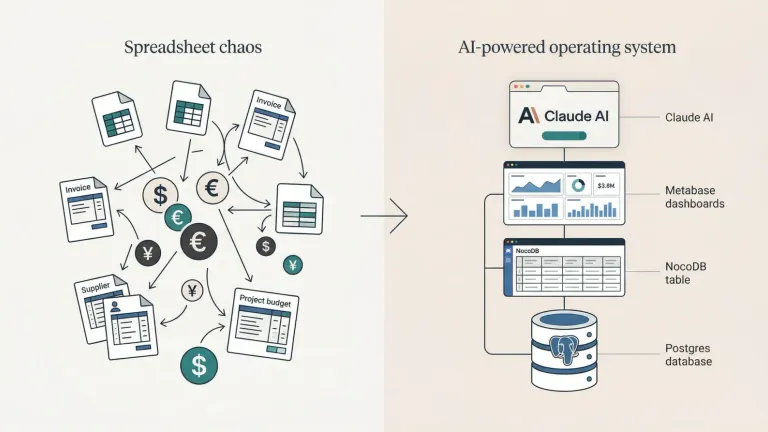
On Wednesday I wrote and published a two-thousand-word Substack article: “How I Replaced Spreadsheet Chaos With an AI-Powered Operating System for My Business.”
Six to eight hours of manual effort, condensed to two to three hours. Cross-posted to LinkedIn, X, and the blog. The article spawned eight X posts as a threaded breakdown. 8,000 impressions, 400 profile views, new Substack subscribers.
One piece of real work became four pieces of content across four platforms. And the loop keeps compounding. Build something, write about it, distribute it, attract the next opportunity.
Agent infrastructure: the compound investment
Three major OpenClaw updates shipped during the week: migrating all AI systems from Anthropic to Ollama-cloud models (Minimax and GLM), remapping 33 automated tasks, and restoring local GPU-powered memory search.
Six to nine hours of direct work. Fifteen to twenty-two hours saved. But the real return is recurring, every improvement to the agent layer saves time every week after.
The human cost
I am not going to pretend this was effortless.
16.1 hours of calls in four days left almost no contiguous deep work blocks. Code commits peaked at 10pm, late-night sessions after the meetings stopped.
My Whoop recovery averaged 64%. Not crisis territory, but not sustainable either. The best day was 81% on Friday, right after the biggest output day. The body handles sprints. The question is whether the average holds.
Six hours fifty minutes of sleep on average is below what I want. The 10.8 hours of sport (walking, running, jiu jitsu) is the counterbalance that I think keeps the wheels on.
And there is a subtler cost. AI accelerates execution so dramatically that the bottleneck shifts from can I do this? to should I do this? When you can build a financial model in an hour or ship a feature in a day, the temptation is to say yes to everything.
The discipline now is not in doing the work. It is in choosing the work.
What this means
This is not a story about working harder. I trained twice, walked 40 kilometres with my wife while she trains for the Camino, went birthday shopping with my son, and had lunches with my wife.
It is a story about what becomes possible when AI is not a single chatbot you open occasionally, but an operating layer across your entire life, strategy, code, content, finances, admin, and family logistics.
The stack is not complicated. It is Claude for reasoning and code, a handful of self-hosted agents for continuous background support, and the discipline to let them run while you focus on the decisions only you can make.
37 to 52 hours saved in four days. An extra working week, conjured from the same calendar.
If you are still thinking about AI as a tool that helps you write emails, you are dramatically underestimating what is already possible.
All data in this article was collected automatically via OpenClaw from Notion, Microsoft Graph, GitHub, Gmail, WHOOP, and X APIs. Time estimates are intentionally conservative.
If you want to follow along as I build this stack in public, subscribe to my Substack or follow me on X.
AI didn’t just make me faster this week. It changed what one person can realistically carry.
I know that sounds like hype. So I measured it.
I am the CTO and COO of Modaso Energy, a renewable energy developer focused on African markets. I build software. I manage a personal investment portfolio. I have a seventeen-year-old whose birthday was this week. I train Brazilian jiu jitsu. I try to sleep.
Last week, 6 to 12 April 2026, a four-day working week because Monday was a public holiday – I tracked everything. Every meeting, every code commit, every trade decision, every article, every walk. All of it flows through my AI systems automatically, so the data was already there. I just had to look at it.
The total estimated time saved across all AI tools: 37 to 52 hours. More than an entire additional working week.
Here is what that actually looked like.
Running a code review from a shopping mall
On Saturday afternoon I was at the mall with my son, birthday shopping. While he was trying on trainers, I pulled out my phone and connected to Claude Code running on my laptop at home using the new remote-control function over Tailscale.
From my phone, in a shoe shop, I kicked off a full testing analysis of one of my apps — browser automation, functional checks, the lot. Claude Code ran the tests, flagged two regressions, and I approved the fixes before we reached Starbucks.
That is not a productivity hack. That is a fundamentally different relationship with work. Deep technical tasks no longer require me to be sitting at a desk. They require me to be reachable for decisions.
The week in numbers
The raw data from the week:
- 16.1 hours of Teams calls across 12 meetings
- 53 code commits, 13,042 net new lines across 101 files
- 7 strategic and financial tasks completed supported by Claude
- 1 long-form article written and published to 4 platforms
- 8,000 impressions, 400 profile views, new Substack subscribers
- 3 major AI infrastructure updates to my Openclaw.
- 2 jiu jitsu sessions, a run, and 40km+ of walks with my wife as she trains for the Camino de Santiago this summer
- Average 6h 50m sleep (Whooptracked)
All in four working days plus the weekend.
The AI layers that made it possible
I don’t use one AI tool. I use separate AI layers for strategy, coding, content, and automation, each tuned for a different kind of thinking.
The game-changer this week was Claude Code. The ability to run a full-stack coding agent in parallel with the rest of my life, in meetings, on the move, even from a shopping mall, is what turned a four-day week into five weeks of output. Nothing else comes close to that compression.
But behind the headline tools, I also run a team of AI sub-agents through OpenClaw, my self-hosted agent framework. They handle the continuous background work that would otherwise pile up between meetings.
James: keeping my head straight in a volatile market
It was an extremely volatile week in the markets. My finance sub-agent James, part of my self-hosted OpenClaw framework, ran continuous portfolio analysis throughout the week. Risk scenarios, exposure breakdowns, strategic action recommendations.
In a normal week I might spend an hour or two reviewing positions. This week, with markets moving sharply, I would have needed hours of focused analysis to stay on top of it. James condensed that into short, decision-ready briefings I could act on between meetings. He flagged the positions that needed attention and told me why. I just had to decide.
Alex: the business coach who doesn’t let you off the hook
Alex is my strategic coaching sub-agent. During the week he pushed me on several decisions I had been deferring, project prioritisation, critical e-mails I had been sitting on, and difficult strategy analysis.
The thing about a human coach is you meet them once a week or once a fortnight. Alex is always there. He picks up context from my tasks, calendar, and conversations, and nudges me when something has been stuck too long. This week he turned three “I’ll think about it” items into “done.”
The executive assistant running the background
My exec assistant sub-agent handled calendar management, admin, and logistics throughout the week. It coordinated meeting slots, managed follow-ups, and handled the small operational tasks that individually take five minutes but collectively eat hours.
The moment that made me smile: it messages my wife with available lunch slots so we could find time together during a packed week. That is not a business metric. But it is exactly the kind of thing that falls through the cracks when you are running too fast and exactly the kind of thing AI should be protecting.

Where the leverage was highest
Financial and strategic work: 5–11x
Claude Teams and Co-work handled the heavy knowledge work. A Kenya DEVEX and MOIC scenario model that would have taken seven hours was done in under one. Meeting minutes drafted. Pitch decks reviewed and updated. Supplier engagement managed across multiple projects.
Across seven tasks, the average leverage was 6.1x. Financial modelling hit 9.3x. Legal work hit 11.5x.
These are structured, domain-specific tasks with clear inputs and outputs, exactly where AI reasoning is strongest.
Software development: weeks into days
53 commits. 101 files. Five product stories shipped, including a major overhaul that would normally take two to three weeks solo. One day alone: 20 commits, 9,399 insertions, 8,000+ net lines. More than many developers produce in a month.
The estimated compression: three to five weeks of focused solo development, delivered in parallel with everything else, often running in the background while I was in meetings or, as mentioned, shopping for birthday presents.
45% feature work, 30% bug fixes, 17% documentation. This was not boilerplate generation. It was full-stack engineering.
Content creation: the multiplier
On Thursday I wrote and published a two-thousand-word Substack article: “How I Replaced Spreadsheet Chaos With an AI-Powered Operating System for My Business.”
Six to eight hours of manual effort, condensed to two to three hours. Cross-posted to LinkedIn, X, and the blog. 8,000 impressions, 400 profile views, new Substack subscribers.
One piece of real work became four pieces of content across four platforms. And the loop keeps compounding. Build something, write about it, distribute it, attract the next opportunity.
Agent infrastructure: the compound investment
Three major OpenClaw updates shipped during the week: migrating all AI systems from Anthropic to Ollama-cloud models (Minimax and GLM), remapping 33 automated tasks, and restoring local GPU-powered memory search.
Six to nine hours of direct work. Fifteen to twenty-two hours saved. But the real return is recurring, every improvement to the agent layer saves time every week after.
The human cost
I am not going to pretend this was effortless.
16.1 hours of calls in four days left almost no contiguous deep work blocks. Code commits peaked at 10pm, late-night sessions after the meetings stopped.
My Whoop recovery averaged 64%. Not crisis territory, but not sustainable either. The best day was 81% on Friday, right after the biggest output day. The body handles sprints. The question is whether the average holds.
Six hours fifty minutes of sleep on average is below what I want. The 10.8 hours of sport (walking, running, jiu jitsu) is the counterbalance that I think keeps the wheels on.
And there is a subtler cost. AI accelerates execution so dramatically that the bottleneck shifts from can I do this? to should I do this? When you can build a financial model in an hour or ship a feature in a day, the temptation is to say yes to everything.
The discipline now is not in doing the work. It is in choosing the work.
What this means
This is not a story about working harder. I trained twice, walked 40 kilometres with my wife while she trains for the Camino, went birthday shopping with my son, and had lunches with my family.
It is a story about what becomes possible when AI is not a single chatbot you open occasionally, but an operating layer across your entire life, strategy, code, content, finances, admin, and family logistics.
The stack is not complicated. It is Claude for reasoning and code, a handful of self-hosted agents for continuous background support, and the discipline to let them run while you focus on the decisions only you can make.
37 to 52 hours saved in four days. An extra working week, conjured from the same calendar.
If you are still thinking about AI as a tool that helps you write emails, you are dramatically underestimating what is already possible.
All data in this article was collected automatically via OpenClaw from Notion, Microsoft Graph, GitHub, Gmail, WHOOP, and X APIs. Time estimates are intentionally conservative.
If you want to follow along as I build this stack in public, subscribe to my Substack or follow me on X.