The problem that made Excel stop being enough for hybrid power
Hybrid renewable projects cannot be designed in disconnected spreadsheets. They need an hourly model that sees the whole system.

I spent much of my career in wind. I had seen how much work goes into getting a good wind project financed, built and operating. But the problem that eventually led me to co-found Converge Hybrid and Modaso Energy did not start with a plan to build a software company.
It started with a spreadsheet that was no longer good enough.
I spoke with Climate Hive about this journey, the transition from selling wind turbines to building hybrid renewable businesses, and why I think wind, solar and batteries will increasingly be designed as one system rather than as separate assets.
Here is the full conversation:
The question behind the model
After leaving GE, I joined a developer looking at very large renewable energy projects. We were trying to understand how wind, solar and batteries could work together to produce stable power. At first, the destination was green hydrogen. But I kept coming back to a more direct question: if we could make renewable power reliable enough for an electrolyser, could we make it more useful for the grid?
The resources were there. The difficult part was working out the right combination of technologies, and whether the resulting project could actually work commercially.
That is a very different question from asking how much electricity a wind farm or solar plant produces in a year.
Why the spreadsheet broke
I began by trying to build the business case in Excel. That is a natural place to start, and it works well for many single-technology projects. But once wind, solar and storage share one grid connection, the important decisions happen hour by hour.
Wind and solar do not produce at the same time. A battery can move electricity, but it adds cost and needs to earn its place. The grid connection has a limit. Some electricity may be curtailed. The price or value of power can change through the day. Equipment degrades over time. Each choice changes the economics of the others.
I could model parts of this separately. I could not see the whole system clearly enough to make a confident decision.
This is an end-to-end problem
The answer is not a bigger spreadsheet. The answer is to bring the technical and commercial decisions into one model, then test the configurations before capital is committed.
In many organisations, one team studies the resource, another estimates equipment costs, another builds the financial model, and another thinks about operations. Each team may do good work, but the project moves through hand-offs. By the time a developer asks whether a different mix of wind, solar and storage would make the project more financeable, the answer can take too long to find.
For hybrid projects, the useful question is not only how much energy the site produces. It is when it produces, what the grid can take, what the offtaker values, and whether the whole project will pencil.
That is the problem we built Converge Hybrid to solve. It allows the generation, grid constraint, pricing and battery dispatch to be considered together, rather than as a sequence of separate reports.
Check if your organisation is ready for the future of renewable energy with our free readiness scorecard: https://scorecard.converge-hybrid.com/hybrid-readiness
The grid is where the pressure is
The interview also covered the broader reason this matters. In many markets, the bottleneck is no longer the ability to build wind or solar. It is the grid connection and the challenge of delivering power when people need it.
A solar project can have an excellent resource, but its connection may sit unused overnight. Wind can often contribute at different times. Storage can help shift energy into more valuable hours. The right answer is always site-specific, but the underlying opportunity is clear: use the infrastructure more intelligently before assuming the only option is to build more of it.
That is not a claim that every site needs a battery, or that every hybrid configuration works. A component should earn its place in the economics and in the operating profile of the project.
A conversation on the work ahead
The problems are not new physics. They are engineering, financing, commercial and policy problems. They are difficult, but they are solvable. The developers who can see the whole system sooner will have a better chance of getting the right projects across the line.
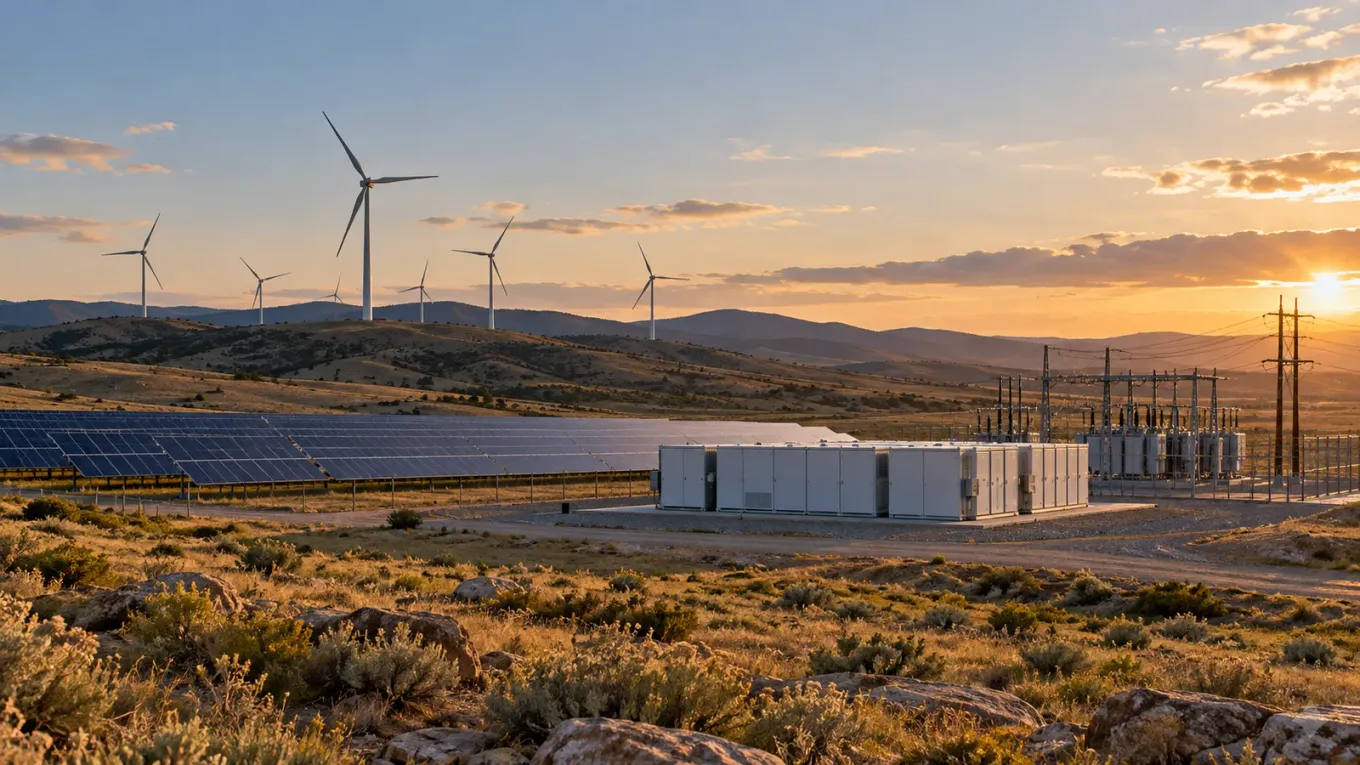
Illustrative AI-generated image, created for this article at Charles’s request. It is not an image of a real project.